Motor technology quietly powers modern production, from conveyor belts to robotic assembly arms. It converts electrical energy into controlled mechanical movement. The right motor can deliver steady torque, accurate positioning, and reliable speed during demanding shifts. Small improvements matter. A smoother drive may reduce product damage, energy waste, and unplanned stops.
A practical question guides this discussion: how does motor technology impact production efficiency? The answer depends on more than motor power. Engineers examine load requirements, duty cycles, operating temperatures, and control systems. Variable frequency drives can adjust speed to match real production needs. Sensors can reveal vibration, overheating, or unusual current patterns before a breakdown interrupts work. In a packaging line, this may protect hourly output and reduce emergency maintenance.
However, motor upgrades are not magic solutions. A poorly aligned shaft can waste the benefits of advanced equipment. Inadequate lubrication may still cause failure. Operators also need training, clear maintenance records, and safe inspection procedures. These details are easy to overlook.
This article explores motor types, control technologies, energy performance, and maintenance practices. It connects technical principles with practical factory examples. Reliable results require evidence, not exaggerated promises. Every facility has different loads, layouts, and production targets. Therefore, the best choice should follow measured data, manufacturer specifications, and qualified engineering judgment. Mistakes remain possible, especially when old equipment lacks accurate monitoring. That limitation deserves honest attention.
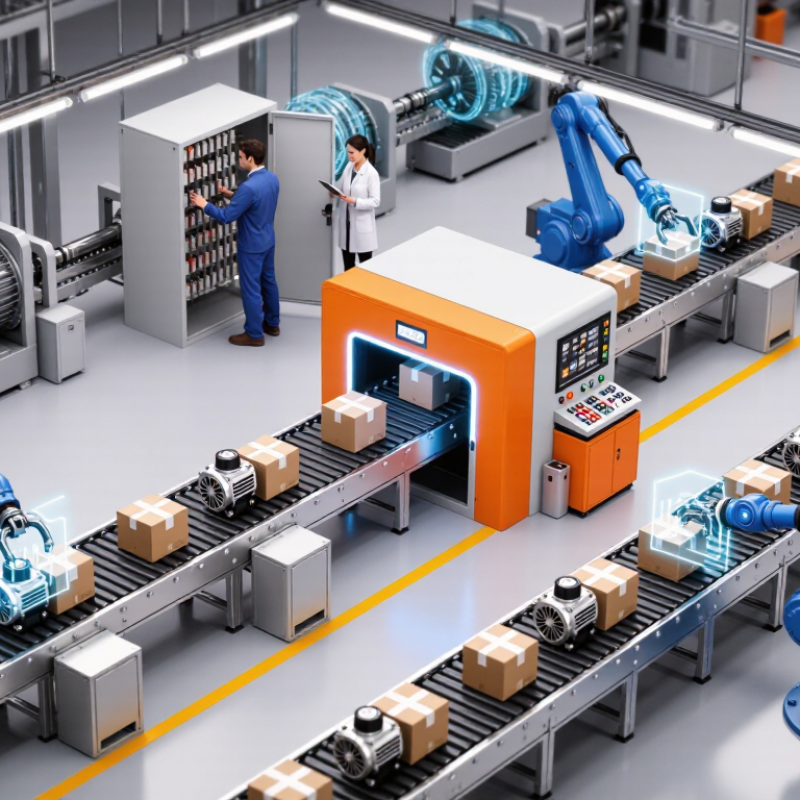
Motors drive about 70% of industrial electricity use, according to the International Energy Agency’s motor-systems analysis. This figure covers pumps, fans, compressors, conveyors, and machine tools. The percentage varies by factory and process. Still, the energy impact is substantial. A small efficiency gain can reduce monthly electricity costs and heat inside production areas.
Modern motor technology combines efficient motor designs, sensors, and variable-speed control. These systems adjust power to actual demand instead of running continuously at full speed. A pump may slow during low-flow periods. A conveyor can also avoid unnecessary acceleration.
The U.S. Department of Energy reports that motor-driven systems represent a major share of industrial energy consumption. Better control can also reduce mechanical stress, unplanned stoppages, and product defects.
However, upgrading hardware alone will not solve every problem. Poor sizing, misaligned shafts, and neglected bearings can waste energy.
Tips: Measure power use during real production shifts. Check load levels, vibration, temperature, and start-stop patterns. Compare the motor’s rated capacity with its actual workload. The IEA recommends system-level assessments, not isolated motor replacements. That advice matters. A highly efficient motor may still perform poorly in an oversized system. Use maintenance records and measured data before investing. Small errors often remain invisible until electricity bills rise.
Motor technology turns electrical energy into controlled mechanical motion, shaping speed, torque, and production consistency. The right motor can move a conveyor smoothly, position a cutting head accurately, or maintain pressure in a pump.
AC motors are durable choices for conveyors, fans, pumps, and mixers. They tolerate demanding environments and usually require limited maintenance. With a variable-frequency drive, operators can adjust speed without changing the motor. DC motors offer simple speed control and strong starting torque. However, brushed DC designs need regular brush inspection. Dust can become a real maintenance problem.
Servo systems use feedback from an encoder to correct position, speed, and torque continuously. They suit robotic joints, packaging axes, and high-speed indexing. They respond quickly, but their controls require careful tuning. Stepper motors move through fixed increments, making them practical for printers, dispensers, and light positioning equipment. They are easier to configure, yet overloads may cause missed steps without obvious warning.
The comparison is not perfectly clean. Motor selection depends on load inertia, duty cycle, acceleration, heat, and required accuracy. A stepper may outperform a servo in a simple, low-cost task. An AC motor may be wasteful for delicate positioning. Measure the real load, not the catalog estimate. A technician should also check vibration, cable routing, and operating temperature during trials. Small assumptions can reduce production gains.
Modern motor technology combines efficient magnetic circuits, improved cooling, accurate controls, and durable bearings. These features help motors convert electrical energy into useful mechanical power with less waste. In some ratings, IE4 motors reach at least 96% efficiency. That figure matters in factories where motors run for thousands of hours each year.
However, IE4 performance depends on operating conditions. Load, voltage, alignment, ventilation, and variable-speed control all influence real results. The nameplate value is not the whole story.
A practical assessment should record power consumption at several loads, not only at full capacity. Maintenance teams should also check vibration, bearing temperature, and cable connections.
Small faults can erase expected savings. That assumption can be wrong. An efficient motor cannot repair an oversized pump or poor control settings.
Engineers should match motor size to the duty cycle and verify measurements after installation. IE4 may cost more initially, yet long operating hours can improve the payback period. The calculation needs local energy prices and actual runtime.
Numbers without field evidence are only estimates.
What Is Motor Technology and How Does It Boost Production?
Variable-speed drives can reduce pump and fan energy use by 20%–50%, according to U.S. Department of Energy motor-system guidance. They achieve this by matching motor speed with real demand. A pump running at 80% speed may deliver sufficient flow without forcing energy through a throttled valve. The result is lower electricity consumption, smoother pressure control, and less mechanical stress.
The International Energy Agency’s Energy Efficiency 2023 report estimates that electric motor-driven systems consume about 53% of global electricity. This makes speed control an important production decision, not merely an equipment upgrade. In a factory, a drive can slow a ventilation fan during quiet shifts or adjust a cooling-water pump as temperature changes. Operators may also see fewer pressure shocks, worn bearings, and emergency stoppages.
The savings are not automatic. Poorly sized motors, unstable sensors, or incorrect minimum-speed settings can reduce performance. Field measurements should record flow, pressure, operating hours, and power before installation. After commissioning, technicians should compare those readings under similar production conditions. A 20% saving on paper may become 12% in practice. That gap deserves investigation. Regular inspection still matters, because an efficient control system cannot compensate for clogged filters, leaking pipes, or neglected maintenance.
Variable-speed drives adjust motor speed to match the required pump or fan output. For centrifugal equipment, the affinity laws show that power varies approximately with the cube of speed, allowing substantial energy savings while maintaining process control.
Energy use index is calculated from the centrifugal-equipment affinity law: power ≈ speed³. Reducing speed to 90% lowers theoretical power use to 72.9%, while 80% speed lowers it to 51.2%—approximately 27% and 49% savings.
What Is Motor Technology and How Does It Boost Production?
Smart Motors and Predictive Maintenance: Real-Time Sensors Reduce Unplanned Downtime
Modern motor technology combines efficient drives, embedded sensors, and software that observes equipment continuously. Vibration, winding temperature, electrical current, and load changes reveal early mechanical stress. A technician may see a small bearing fault before a conveyor stops. The warning can arrive while production is still running.
McKinsey reports that predictive maintenance can reduce machine downtime by 30–50% and extend machine life by 20–40%. Deloitte’s predictive maintenance research also links condition-based maintenance with lower costs and improved asset availability. These figures are persuasive, but they are not automatic guarantees. Sensor quality, installation, data history, and technician response matter greatly.
A practical system compares real-time readings with each motor’s normal operating pattern. A rising vibration signal might trigger inspection, lubrication, or alignment work during a planned shift. That is very different from discovering a seized bearing beside a silent production line. The dashboard helps, but it cannot replace experience. False alarms still happen. Poorly mounted sensors can mislead teams. Operators should question unusual data instead of accepting every alert blindly. McKinsey’s analysis also stresses that predictive maintenance requires reliable data and disciplined workflows. In the plant, a simple alert, clear ownership, and a documented repair often create more value than an impressive but confusing analytics platform.
Operational comparison of conventional motor management and sensor-enabled smart motor systems using commonly reported industrial benchmark ranges.
| Performance Dimension | Conventional Motor Management | Smart Motor with Predictive Maintenance | Production Benefit |
|---|---|---|---|
| Condition Visibility | Periodic inspections and manual readings provide intermittent information. | Continuous monitoring of vibration, temperature, current, voltage, speed and operating load. | Abnormal behavior can be identified while the motor is still operating normally. |
| Fault Detection | Problems are often detected after a noticeable noise, temperature rise, trip or production interruption. | Sensor trends and alarm thresholds can identify developing bearing, alignment, overload and electrical faults. | Maintenance teams can respond before a minor defect becomes a major failure. |
| Typical Warning Lead Time | Usually limited to the time between scheduled inspections or an observable failure symptom. | Days to weeks for many developing mechanical faults, depending on load, sensor quality and fault type. | Planned work can be scheduled during a suitable production window instead of during an emergency. |
| Unplanned Downtime | Unexpected motor failures can stop an individual machine or an entire connected process. | Predictive maintenance programs commonly report approximately 30–50% lower unplanned downtime when correctly implemented. | Higher equipment availability and fewer production stoppages. |
| Maintenance Cost | Reactive repairs may require overtime labor, expedited parts and secondary equipment repairs. | Condition-based work commonly reduces maintenance expenditure by approximately 10–40%, depending on asset criticality and program maturity. | Maintenance resources are directed toward assets that show measurable degradation. |
| Failure Events | Failure occurs before the root cause is fully understood, increasing the risk of repeat incidents. | Trend history helps identify recurring causes such as misalignment, imbalance, lubrication problems and electrical overload. | Fewer repeat failures and more effective corrective actions. |
| Energy Monitoring | Energy use is often reviewed at the facility or machine level rather than continuously at the motor. | Real-time current, voltage, power factor and load data can reveal inefficient operation and overload conditions. | Improved load management and earlier identification of energy waste. |
| Motor Efficiency | Efficiency may decline unnoticed because of poor alignment, worn bearings, imbalance or inappropriate loading. | Operating data supports corrective actions that help maintain the motor within its intended load and efficiency range. | Lower operating costs and reduced thermal stress on the motor. |
| Production Availability | Availability depends heavily on fixed maintenance intervals and spare-motor readiness. | Maintenance timing is based on actual asset condition and production priority. | More predictable production scheduling and improved asset utilization. |
| Data Frequency | Data is typically collected during rounds, inspections or periodic testing. | Measurements can be collected continuously or at configurable intervals, from seconds to hours. | Faster response to rapid changes in temperature, vibration or electrical load. |
| Integration Capability | Maintenance records may remain separate from control and production systems. | Sensor data can be connected to maintenance software, industrial control systems and dashboards through standard interfaces. | Operators, engineers and maintenance teams can work from a shared operational view. |
| Return on Investment Drivers | Savings mainly come from repairing equipment after a failure. | Value comes from avoided downtime, lower emergency labor, optimized spare parts and better energy control. | The strongest business case is usually found on critical motors where one failure has a high production cost. |
Motors use about 70% of industrial electricity. This includes pumps, fans, compressors, conveyors, and machine tools.
Sensors and variable-speed controls match power with demand. This can reduce heat, mechanical stress, stoppages, and product defects.
It prevents equipment from running at full speed unnecessarily. A pump can slow during low-flow periods.
Some IE4 motors reach at least 96% efficiency at certain ratings. Actual results depend on operating conditions.
No. An oversized pump, poor alignment, or weak control settings can erase expected savings.
They should record power use, load levels, vibration, temperature, and start-stop patterns during real production shifts.
Misaligned shafts, worn bearings, poor ventilation, and loose cable connections can increase losses and heat.
Compare the motor’s rated capacity with its actual workload and duty cycle. Full-capacity operation is not always necessary.
Use actual runtime, local electricity prices, measured power use, and installation costs. Estimates without field evidence may mislead.
They should recheck power use, temperature, vibration, and operating loads. The first assumption may be wrong.
Motor technology is central to modern manufacturing because motors account for roughly 70% of industrial electricity consumption. Understanding how does motor technology impact production efficiency begins with selecting the right motor for each application. AC motors are widely used for reliable, continuous operation, while DC motors offer straightforward speed control. Servo motors deliver precise movement for automated systems, and stepper motors provide accurate positioning in lower-speed applications. Choosing the appropriate type can improve productivity, reduce energy waste, and support consistent product quality.
Efficiency-focused designs also contribute significantly to operational savings. IE4 motors can achieve at least 96% efficiency in certain power ratings, reducing electricity losses during continuous use. Variable-speed drives adjust motor output to actual demand and can lower pump and fan energy consumption by approximately 20%–50%. In addition, smart motors equipped with real-time sensors can monitor temperature, vibration, and performance conditions. This data enables predictive maintenance, helping teams identify problems earlier, reduce unplanned downtime, extend equipment life, and maintain smoother production.

RedCat Motors